34.9K
Downloads
406
Episodes
The study of the Bible in its historical context - with a focus on the archaeology, history, geography, customs , culture, and even the languages of the ancient Middle East. WE ask what did they understand THEN - the original intent of the Lord - so that we can expand and enrich our understanding NOW and thus become true disciples of Adonai Yeshua as in John 8:31-32.
Episodes
Tuesday Mar 31, 2026
Tuesday Mar 31, 2026

A Place Called Gethsemane
The Passion Week account of Jesus happens during the annual feast of Passover for the Jews. This is one of three times that every Jew was required to travel to Jerusalem to celebrate the feast. Jesus being a devout Jew went to the city as well not only for the feast but to complete His awesome mission. Not every Jew in the world could possibly come but it is estimated that 1 to 1.5 million people would be in the city during Passover. The picture below from the Temple Institute in Israel shows the 1000’s entering the city at Passover.

Since Jerusalem was a city of perhaps an estimated population 35,000 to 80,000 depending on the archaeologist, it is clear that the city could not handle such a dramatic increase in population. Every extra room was rented and those not finding rooms camped out on the hills nearby or they sought lodging in nearby towns like Bethlehem or Bethany. Many of those who camped out in the hills around Jerusalem would more than likely camp on the beautiful slopes of the surrounding hills like Mount of Olives east of Jerusalem. (Vander Laan 177)
After Jesus and His apostles had completed the Passover Seder meal they went to the Mount of Olives to a place called Gethsemane at the Mount of Olives in an olive grove. The account can be found in Matt 26:36, Mark 14:32, Luke 22:39 and John 18:1. The word Gethsemane is the English transliteration of a Greek word which was based on two Hebrew words. (Picture below from Permaculture Research Institute, is a good idea of what the side of the Mt. of Olives would have looked like in Jesus’ day).

The first was GAT. The Hebrew word stands for a press. The second word is SHEMIN which means oil – like olive oil. The plural in Hebrew is Sheminim. Thus, Gat Sheminim means a press for oils and referred to in most cases an olive press. (Vander Laan 178)
Today in Israel one can visit Tel Maresha in the Negev. At this tel archaeologists found the remains of a perfectly intact olive press. Olive presses were built in caves close to an olive grove. The cave itself would have “windows” cut into the walls and an air shaft in the roof. These “windows” and the airshaft were used to control the airflow and temperature since processing olives required a certain temperature range. The olives themselves were processed by first smashing them with a millstone to break open the skins. The smashed olives were then put into special porous bags and crushed under the weight of huge weighted down cypress logs in the main press room. The olive oil would run down into a basin which had a drain directly into a collection jar below the pile of bags of crushed olive pulp. The jar of oil would be sealed when filled and made ready to be taken to market. (Vander Laan 178) The picture below is of the Gat Sheminim at Tel Maresha Israel courtesy of Israel Travel Inc.

Where is this exact location of where Jesus prayed and is there a connection to the Gat Sheminim and the word Gethsemane? As far as location is concerned, “Christian tradition has always placed Gethsemane on the lower slopes of the Mount of Olives – though today the Roman Catholic and Russian Orthodox churches hallow different sites.” (Reader’s Digest 186) Recently, however, archaeologists working at the base of the Mount of Olives made a very interesting discovery. “A cave nearby was recently identified as containing an ancient olive press. Early 6th century tradition supports this cave as being Jesus’ Gethsemane.” (Vander Laan 179) Moreover, no archaeological evidence nor evidence from ancient descriptions of the city of Jerusalem and its surroundings as ever found a place called the Garden of Gethsemane. This name is a modern label attached to an area that tourists would come to experience what the place called Gethsemane in the Bible was like. “The designation ‘Gethsemane’ does not occur outside the gospels. Even Luke 22:39 omits the name, using the more general description, ‘the Mount of Olives.’”(Flusser 251) What we know for a fact is that the Mount of Olives had an olive grove and near olive groves one will find a Gat Sheminim or an olive press.
One might conjecture the following based upon the fact that in the Jewish culture God taught His people difficult theological truths with the use of pictures – as in the case of the word tekton and 1 Peter 2:4-6. Jesus went to the Mount of Olives and entered the gat sheminim, or the olive press, to find a secluded place to pray. He would prefer the seclusion of the press since there were many possible pilgrims camping out on the slopes of the hill for Passover and the press would be located in a quiet cave. Perhaps Jesus knew the owner and was able to gain private access to the olive press. Again, all of this is conjecture but it is based on the archaeological evidence that is factual.
In the gat sheminim, or in a location very close, we know that Jesus prayed and was in deep stress and anguish. In the account found in Luke 22:44 Jesus’ sweat was like drops of blood. What is intriguing about this picture is a verse found in Isaiah 53:5. This verse for us Christians says He was crushed for our inequities. When one makes the connection between the discovery of the olive press and how it was used and these verses it would seem that God is showing us how Jesus was crushed – like an olive crushed by the weight of a huge cypress log with heavy weights attached. It would seem that God Himself is making use of the archaeological discoveries to open up the world of the Bible to us so that its meaning is enhanced. Do we know for a fact that Jesus was in the olive press or the Gat Sheminim? No we do not. But, these discoveries perhaps are given to us to intensify our understanding of His word and the picture of the gat sheminim can simply be used to help us understand the scope of Jesus’ stress and anxiety that horrible night.
Works Cited
* That the World May Know Set 3 Ray Vander Laan c 1996 Focus on the Family Publishing Colorado Springs CO
* Egypt and Bible History: C. Aling Baker House book Grand Rapids MI c 1981
* “Reader’s Digest Atlas of the Bible”, C 1981 Reader’s digest, Plesantville, NY
* “Jesus”, David Flusser, Magnes Press, Hebrew Univ., Jerusalem, 1998
* Josephus WAR 5:141
* “First Easter: The True and Unfamiliar Story”, Paul L. Maier, Harper and Row, NY 1973.
* Archaeology and the Bible: The Best of Biblical Archaeology Review, “The Garden Tomb: Was Jesus Buried Here?”, Gabriel Barkay, Vol. II, Archaeology in the World of Herod, Jesus and Paul.
Rev. Ferret - who is this guy?
(John & Robin somewhere in the Middle East)

What's his background? Why should I listen to him? Check his background at this link - https://www.dropbox.com/s/ortnret3oxcicu4/BackgrndTeacher%20mar%2025%202020.pdf?dl=0
Monday Mar 30, 2026
Monday Mar 30, 2026


We are still in an interlude. We started Exodus 12 and did not go directly to the 10th and last plague. Instead, before the awesome hammer of the Lord falls on Egypt and the firstborn, the Lord instructs Moses to teach Israel about Passover and the Feast of Unleavened Bread.
Our focus in lesson 36 will be on Exod. 12:14-28 and we will deal with three major concepts as it relates to Passover and the Feast of Unleavened Bread.
The first concept is the command by the Lord that Israel will do a special celebration annually forever as a memorial, a celebration to remember the awesome great things God did for Israel in Egypt. The Hebrew word used for memorial is זִכְרוֹן zikrôn H2146. So the Feast of Unleavened Bread is a 7 day feast to be a remembrance of their great deliverance by the Lord out of Egypt.
What is interesting is that the TORAH deals with this concept of remembering quite a lot. God sets up so many rituals and practices used by His people to remember. Many Jewish religious men, for example, wear four tassels. This is based on the TORAH in Num. 15:37-4. It is practiced today and in Jesus’ day. One of Jesus’ tassels was touched by a woman with a bleeding disease and was instantly healed. She didn’t touch the fringe of His outer cloak but one of the four tassels on the four corners.
This command by the Lord for His men to wear the tassels is specifically for one purpose. They are to remember God’s commands, laws, and instructions to live as His people as they see the tassels. An example of God’s interest in us to remember.
The second concept is studying the phrase “cut off from Israel” or “cut off from the people.” The Hebrew word for this penalty is KARAT כָּרַת H3772. It means to be cut or severed or separated. This is a very interesting penalty that is associated with seemingly trivial matters. For example, if one goes to work on the Sabbath one is cut off from Israel. Another way to get cut off from Israel is to eat a piece of leavened bread during the feast – even if no one sees you. These seemingly trivial matters you do to receive KARAT כָּרַת also can never be forgiven. The rabbis think it is so serious that if one receives KARAT, cut off from Israel, one will not enter the World to Come or experience the resuscitation of the dead. For Christians that is like saying one will not get into heaven or ever be resurrected from the dead. So, this idea of KARAT is a big deal. One can find it over and over again in the Torah.
The last concept we will deal with is connected to the picture below.
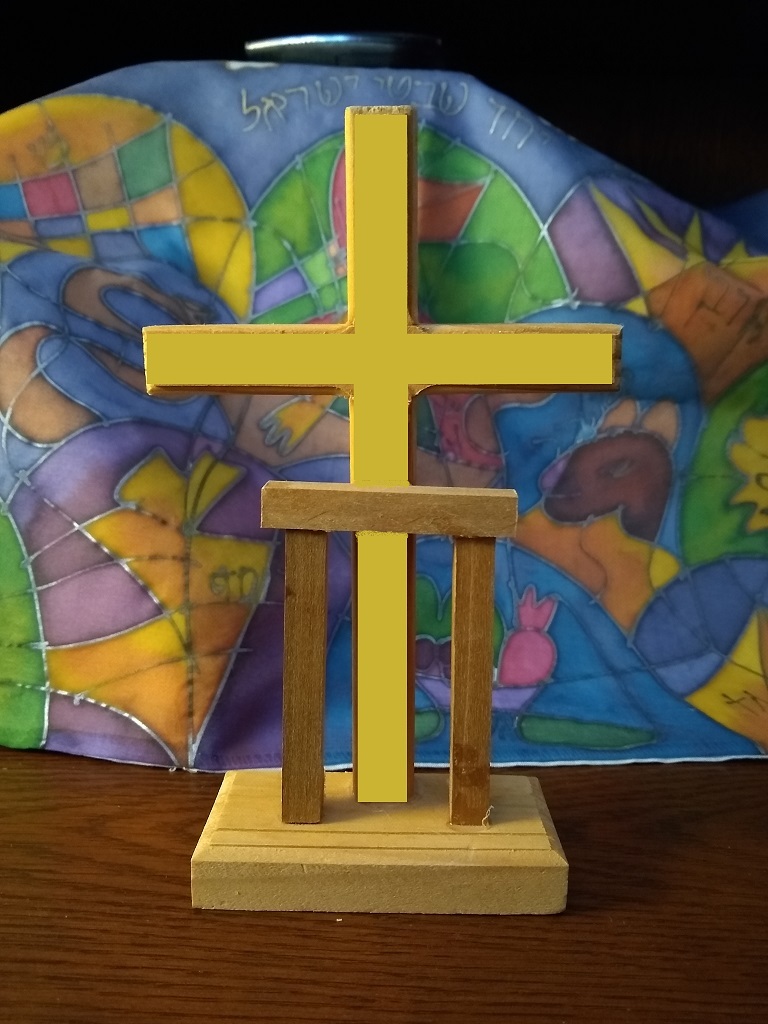
This is a decoration my wife and I have on our table when we celebrate what we call, “The Passover Meal of the Messiah.” It is normally called Jesus’ Last Supper. You will notice it is a cross with a doorway attached – a doorway with its two doorposts and the cross beam or lintel. We recall that the lamb of the Passover is sacrificed and the blood is “painted” on the wood; it is smeared on the doorposts and lintel. God says that when He sees that those inside the house will be spared from His being poured out across Egypt. Hmmm. This seems to be directly connected to Jesus who is the Lamb of God crucified on Passover. He was on the cross for some 6 hours. The blood of the Lamb of God flowed onto the wood; His blood stained the wood of the cross. Paul writes about this.
Much more then, having now been justified by His blood, we shall be saved from the wrath of God through Him. (Rom 5:9)
This is so connected to the Exodus. It is so connected to the first time God saved His people from His wrath. So the cross and the doorway seem to be connected. In this lesson we will again see that Jesus’ words are true when He said that ALL SCRIPTURE testifies of Himself. Where is He in TORAH? Right in front of us.
Who is this guy, Rev. Ferret?

(Ferret - hiking in a wadi in the Judean Wilderness)
What's his background? Why should we take time to listen to him? Here's a link to check out his background - https://www.dropbox.com/s/ortnret3oxcicu4/BackgrndTeacher%20mar%2025%202020.pdf?dl=0
Sunday Mar 29, 2026
Sunday Mar 29, 2026

Session 2 - we continue our focus on the 1st Palm Sunday probably in 30 A.D. We ask why did the Lord pick this day to ride into Jerusalem? Was it just the day that was convenient or was it part of a plan? Is there something about this Sunday that they understood almost 2000 years ago but we don't since we are not Jewish and we did not live then. And what's the deal about the palm branches? In those days the palm branch to the Jews was not a symbol of victory like Rome or Greece - that's a pagan meaning and devout religious Jews would never use such a pagan meaning. For the Jews then it was the symbol of the land of Israel. If you waved a palm branch in Jesus' day as they did it's like us raising the American flag today like after 9/11 and shouting out, "USA, USA, USA!" Waving palm branches was a patriotic gesture in those times in Israel. So, let's delve into our continued study and walk those ancient streets and paths to try and grasp what they knew, what they understood so that the Bible's meaning for us is enhanced and our walk with Rabbi Jesus becomes more passionate and committed.
Here's links to some awesome articles that will enhance your study ...
The article from Jerusalem Perspective on Jesus' last ride into Jerusalem - https://www.jerusalemperspective.com/1402/
Rev. Ferret's graduate paper on the archaeology of the Passion of Jesus - https://www.dropbox.com/s/28fu8ay951lwy3u/NWC%20Paper%20Passion%20Week%202020%20revised.pdf?dl=0
Rev. Ferret - who is this guy? (Teaching in Mexico in the desert)

What's his background? Why should I listen to him? Check his background at this link - https://www.dropbox.com/s/ortnret3oxcicu4/BackgrndTeacher%20mar%2025%202020.pdf?dl=0
Saturday Mar 28, 2026
Saturday Mar 28, 2026

Palm Sunday is a key holy day in the church. It marks the start of Passion Week. It also is a remembrance of Jesus' "triumphal" ride into Jerusalem. But, did this happen on a Sunday? It seems from the resources we have that the earliest date of the celebration of Palm Sunday is from the 4th century. That is close to 300 some years after Jesus ascended to heaven. That is a big gap.
This session will show that there is evidence to suggest a real possibility that Jesus did ride into Jerusalem on a Sunday. If this is the case, however, putting this event back into its historical context may challenge our long held traditions. However, as we examine the archaeology, the history, and the ancient customs of those days we will find it strengthens our doctrine - it strengthens our walk of faith.
This is session 1 of a four part series on archaeology and the Passover. Watch for the other three lessons coming soon.
One of my teachers and now a friend, Dr. Carl Rasmussen, professor emeritus of Bethel University, scholar and Bible historian extraordinaire, has an awesome website called Holy Land Photos. I am linking you to one of 100's and 100's of collections he has gathered of pictures of religious and archaeological sites across the Middle East. Here is the link to the collection of pictures of the Mt. of Olives. I know you'll love and it'll add to your study in this four part series.
Link - https://holylandphotos.org/browse.asp?s=1,2,6,19,451
Who is this guy, Rev. Ferret? (John & Robin at the airport on their way to the Middle East again)

What's his background? Why should we take time to listen to him? Here's a link to check out his background - https://www.dropbox.com/s/ortnret3oxcicu4/BackgrndTeacher%20mar%2025%202020.pdf?dl=0
Session Two coming soon
"The Palm and the Lamb"
Why did Jesus ride in on a Sunday? What's the big deal? What does it mean for me today? Just wait!!
Friday Mar 27, 2026
Friday Mar 27, 2026
TRUTH NUGGET #17
Jesus is the Lamb of God and the original Bible never says He is the Passover Lamb. This is clear in the ancient Greek manuscripts like Codex Sinaiticus dated to 330 A.D. We said He is the Passover Lamb. It is easy to see why but the Bible like the NASB or the KJV, the best translations from the ancient Greek and the Hebrew, state Jesus is the Passover and NOT the Passover Lamb in 1 Cor. 5:7. But, if we see Jesus as distinct from the Passover Lamb, if we see Jesus as the Lamb of God, these lambs on Passover create an amazing picture of God's redemption of His people, Israel, through Moses the first redeemer, and God's ultimate redemption of Jew and Gentile, the whole world, through Messiah Jesus the Ultimate Redeemer. Once again God has created an amazing literary structure in His Bible that creates a mirror to help us see His awesome truth. Let us now study the Mirror of Passover and see the centrality of the Cross from Genesis to Revelation.
Rev. Ferret - who is this guy?
What's his background? Why should I listen to him? Check his background at this link - https://www.dropbox.com/s/ortnret3oxcicu4/BackgrndTeacher%20mar%2025%202020.pdf?dl=0
Wednesday Mar 25, 2026

Monday Mar 23, 2026

Sunday Mar 22, 2026

Saturday Mar 21, 2026
Saturday Mar 21, 2026

SOURCES
Shown below are the sources and references that I used that support this video lesson. Again, I don't teach my own opinion. These sources will provide you with a good initial start into each of the topics in the video.
And, remember, as we enter "The Coming Darkness" that we are more than conquerors as in Rom. 8:37. On top of that, as we are in the times of the end, Yeshua said He is always with us as in Matt. 28:20. So we go forward and know we are to be brave and courageous as the battle is not ours but the battle belongs to the Lord and with us is the remnant of disciples of Rav Yeshua all of us shining as lights to the world for all who are facing "The Coming Darkness" without a firm covenant relationship with the one true and only God.
Millennials and GenZers lack a Biblical Worldview
Only 2% of Millennials (1% for GenZers) hold a biblical worldview, the lowest among all adult generations, reflecting a significant, long-term shift away from traditional Christian, biblical, and moral principles toward secular or syncretic beliefs. This decline is driven by disillusionment with institutional church, cultural skepticism, and a preference for moralistic therapeutic deism.
Pastors Lack a Biblical Worldview
A significant portion of pastors lack formal theological training or, in some studies, hold a non-biblical, syncretic worldview (63%), leading to a neglect of deep scriptural study. Factors include prioritizing "relevant," topic-driven sermons over expository teaching, lack of preparation, and, in some cases, a lack of personal biblical conviction.
[1] https://www.mnnonline.org/news/62-of-pastors-worldwide-have-no-training/
[3] https://www.equippinghearts.com/blog/7-reasons-why-small-groups-become-big-gripes-for-pastors
[4] https://ehrmanblog.org/why-dont-pastors-teach-what-they-know-about-the-bible/
[5] https://drmsh.com/why-you-dont-learn-much-bible-in-church/
Key Trends in Global Christianity
Between 2010 and 2020, countries like the UK, Australia, and the U.S. shifted away from Christian majorities, with many people moving towards no religious affiliation. In the U.S., the Christian population dropped from 78% in 2007 to roughly 62% in 2025. By 2050, it is projected that nearly twice as many Christians will live in Africa as in Europe and North America combined. The number of religiously unaffiliated individuals (labeled the "NONES") is increasing, particularly in the West.
While Christianity declines in the West, Islam is growing faster, expected to nearly equal the number of Christians globally by 2050. Europe experienced a drop of approximately 17 million Christians in the five years leading to 2025. In the United States the decline has been rapid over the past decade, though some studies suggest it may be stabilizing. In Africa/Asia are seeing significant growth in Christian adherence, despite high risks of persecution in some areas.
[1] https://research.lifeway.com/2024/02/05/5-discouraging-trends-in-global-christianity/
[3] https://www.pewresearch.org/religion/2015/04/02/religious-projections-2010-2050/
[5] https://research.lifeway.com/2025/02/25/6-discouraging-trends-in-global-christianity-in-2025/
[6] https://research.lifeway.com/2025/02/11/9-encouraging-trends-for-global-christianity-in-2025/
What is a Biblical Worldview
A biblical worldview is a framework based on the Bible as absolute truth, viewing God as the sovereign Creator and sustainer of all things. Key characteristics include recognizing human sinfulness, finding redemption only through Jesus Christ, upholding objective moral values, and living with an eternal perspective focused on loving and serving God.
[1] https://libertychristian.org/blog/complete-guide-to-developing-a-christian-worldview
[3] https://homeschooladventure.com/what-is-a-biblical-worldview/
[4] https://www.liberty.edu/arts-sciences/history/biblical-worldview-principles/
[5] https://www.focusonthefamily.com/live-it-post/core-principles-of-the-christian-worldview/
[6] https://www.mhbs.org/resources/biblical-worldview.cfm
[7] https://www.scribd.com/document/131358587/Worldviews-Chart
What is Bible Literacy
It’s the ability to rightly READ and understand the Bible by using the proper tools of STUDY to become better acquainted with its essential nature and content and then apply discerned meaning to life. Bible reading is a must for any Christian; especialy daily. But, to be Bible LITERATE it means reading and study to attain Bible literacy. It requires personal interaction—and approaching the Bible for what it is: alive and active, God’s living Word (Heb. 4:12)
- https://www.crossway.org/articles/lets-talk-about-our-bible-literacy-problem/
- https://www.logos.com/grow/biblical-literacy/
- https://www.gotquestions.org/study-to-show-yourself-approved.html
- https://www.realworldbiblestudy.com/bible-reading-vs-bible-study/
- https://www.ligonier.org/podcasts/ask-ligonier/is-there-a-difference-between-studying-the-bible-and-reading-it-devotionally
- https://onedeterminedlife.com/reading-bible-and-studying-bible/
- https://www.gotquestions.org/why-read-Bible.html
- https://albertmohler.com/2016/01/20/the-scandal-of-biblical-illiteracy-its-our-problem-4
- Study is the Highest form of worship ...
RABBI ELIEZER
Repent the day before you will die
תְּנַן הָתָם, רַבִּי אֱלִיעֶזֶר אוֹמֵר: שׁוּב יוֹם אֶחָד לִפְנֵי מִיתָתֶךָ. שָׁאֲלוּ תַּלְמִידָיו אֶת רַבִּי אֱלִיעֶזֶר: וְכִי אָדָם יוֹדֵעַ אֵיזֶהוּ יוֹם יָמוּת? אָמַר לָהֶן: וְכׇל שֶׁכֵּן, יָשׁוּב הַיּוֹם, שֶׁמָּא יָמוּת לְמָחָר, וְנִמְצָא כׇּל יָמָיו בִּתְשׁוּבָה. וְאַף שְׁלֹמֹה אָמַר בְּחׇכְמָתוֹ: ״בְּכׇל עֵת יִהְיוּ בְגָדֶיךָ לְבָנִים וְשֶׁמֶן עַל רֹאשְׁךָ אַל יֶחְסָר״.
We learned there in a mishna that Rabbi Eliezer says: Repent one day before your death. Rabbi Eliezer’s students asked him: But does a person know the day on which he will die? He said to them: All the more so this is a good piece of advice, and one should repent today lest he die tomorrow; and by following this advice one will spend his entire life in a state of repentance. (Babylonian Talmud, Shabbat 153a:5 - https://www.sefaria.org/Shabbat.153a.5?lang=bi)
For some Religion & Faith are not Important
The rise of the religious “nones” is continuing, according to new data, with the percentage of Americans who consider religion “very important” to their lives now dipping below 50%.
Newly published data from Gallup (Gallup article - https://news.gallup.com/poll/702572/americans-religious-engagement-holds-lower-levels.aspx) found that, in 2025, the share of U.S. adults who identified as “nones” — those with no religious affiliation at all — reached a record high of 24%, up from 21% and 22% the previous four years. Additionally, 28% said religion is “not very important” in their lives.
The just-released study showed less than half (47%) of American adults say religion is “very important” to their lives, while another 25% described it as “fairly important” to them.
(Accessible at https://cbn.com/news/us/staggering-new-data-reveals-decline-importance-faith-americans-lives)
What is a Disciple
Since receiving his Master's of Divinity from Westminster Theological Seminary in 1976, Ray Vander Laan has been actively involved in studying and teaching Jewish culture using the methods of Jewish education. He founded That the World May Know Ministries in 1998. Ray has taken over 10,000 people with him on his study tours of Israel, Turkey and Egypt.
Ray's preaching and teaching ministry is focused on understanding the Bible in light of the historical and cultural context in which God placed it. This perspective on the Bible highlights God's call for His people to be a transforming influence on their culture. He uses research of the top scholars in the fields of archaeology, history, and Biblical study as tools to explore the Biblical text ever more deeply. His gifts, expertise, and calling are to link that cultural information and the Bible so that its message applies to our lives today in very practical ways.
Below are four audio lessons on what Jesus meant when He commanded the church to go and make disciples. There’s a lot more that can be found at the ministry’s – That the World May Know) website - https://www.thattheworldmayknow.com/
- Disciple 1 – https://www.thattheworldmayknow.com/preview/1539
- Disciple 2 – https://www.thattheworldmayknow.com/preview/1540
- Disciple 3 – https://www.thattheworldmayknow.com/preview/1542
- A Disciple’s Passion - https://www.thattheworldmayknow.com/preview/1551
Churches abandoning Bible Study
Many churches are moving away from in-depth, systematic Bible studies in favor of topical preaching, often due to a lack of member interest, fear of addressing complex topics, and a preference for shorter, less demanding services. The lack of study contributes to a decline in believers' ability to understand or apply the Bible, creating a reliance on superficial teaching. Low engagement with the Bible has resulted in many young people, even those who attend church, having little understanding of the Bible.
[1] https://www.youtube.com/watch?v=Dl4aAMWo7Sc
[2] https://www.quora.com/Why-do-churches-rarely-offer-a-serious-Bible-study
[3] https://www.quora.com/Why-do-churches-rarely-offer-a-serious-Bible-study
[4] http://www.teachingtheword.org/apps/articles/?articleid=77516&columnid=5449
[6] https://www.youtube.com/watch?v=zVH1GEyIUxQ
[7] https://www.quora.com/Why-do-churches-rarely-offer-a-serious-Bible-study
[8] https://www.thegospelcoalition.org/article/why-bible-study-doesnt-transform-us/
[9] https://www.quora.com/Why-do-churches-rarely-offer-a-serious-Bible-study
[10] https://www.crossway.org/articles/why-bible-study-isnt-enough/
[11] Study is the Highest form of worship ...
Antisemitism (Jew Hatred) increases dramatically
Antisemitic incidents in the United States have reached record-high levels in 2024, marking a consistent and rapid increase following the October 7, 2023, Hamas attack on Israel. Data from the Anti-Defamation League (ADL - https://www.adl.org/audit-antisemitic-incidents) indicates a 5% increase in 2024 over the previous record-setting year of 2023, with over 9,354 incidents recorded—a 344% increase over the past five years and a 893% increase over the past ten years.
For the first time, a majority (56%) of American Jews reported changing their behavior out of fear, such as hiding their Jewish identity or avoiding public events.
The rise in antisemitism or Jew hatred is not isolated to the U.S. Preliminary data from the J7 Task Force—representing major Jewish communities in the US, Canada, UK, Germany, France, Australia, and Argentina—showed a continued, rapid rise in antisemitic incidents across all these nations.
[2] https://www.adl.org/audit-antisemitic-incidents
[4] https://www.bbc.com/news/articles/c9wkxv9d99vo
[5] https://thehill.com/opinion/civil-rights/5279327-antisemitic-harassment-rise/
[6] https://www.ajc.org/AntisemitismReport2024
[9] https://www.adl.org/resources/report/audit-antisemitic-incidents-2024
Rev. Ferret - who is this guy?

(Ferret - somewhere in Timnah Park - site of the Tabernacle)
What's his background? Why should I listen to him? Check his background at this link - https://www.dropbox.com/s/ortnret3oxcicu4/BackgrndTeacher%20mar%2025%202020.pdf?dl=0
Tuesday Mar 17, 2026
Tuesday Mar 17, 2026

GOD'S NEW YEAR!
March 18th at sunset
Our New Year on January 1st has nothing to do with Jesus, the Bible, His birth, or the Good News. Matter of fact New Year on January 1st has a pagan beginning. Julius Caesar started it with his Julian Calendar in 46 B.C. Caesar names the 1st month JANUS where we get January. Janus was a two headed god that seemed to look to the past and the future simultaneously (https://www.britannica.com/topic/Janus-Roman-god). Later Pope Gregory the 13th (1582) fixed the Julian Calendar and so we got the Gregorian Calendar and it too agreed with Julius Caesar that January 1st is the New year. Check out the link for a great review of the history of the New Year -https://www.britannica.com/story/why-does-the-new-year-start-on-january-1
In Judaism by the eary 2nd century A.D. Jewish people started celebrating their own made up new year. It is unbiblical and it was made up by the Jewish scholars and rabbis in those days. It was called Rosh HaShana (in Hebrew it means the head of the year) and the name was used to rename an actual feast of God, Yom Teruah, the feast of the blast or the feast of the shofar blast. It was NOT practiced in Jesus' day as Rosh HaShana but the day may have had special rituals since it was a feast commanded by God and not the rabbis as we find in Lev. 23: 24-25.
"Speak to the sons of Israel, saying, 'In the seventh month on the first of the month you shall have a rest, a reminder by blowing of trumpets, a holy convocation. 'You shall not do any laborious work, but you shall present an offering by fire to the LORD.'" (Lev 23:24-25)
Please check out the Bible study podcasts that go into the real history of Rosh HaShana. It is an amzing man-made (rabbi-made) feast that is NOT in the Bible. It has nothing to do with Jesus or His birth. However, there are some awesome connections to the feast of the Lord called Yom Teruah, the feast of the Shofar blast. Here's the link to the studies you may find very intersting ... https://youtu.be/ssiam-Y3FdU?si=-otXRRHR-mLBrcCo
There are other new year celebrations. Here's just a sample of a few of them ...
- Hogmanay (Scotland):** A famous New Year's Eve celebration.
- Nowruz (Persian):** Marks the vernal equinox (around March 20) with feasts and spring celebrations.
- Songkran (Thailand):** A water festival in April.
- Enkutatash (Ethiopian):** Celebrated in September, marking the end of the rainy season.
- Hijri New Year (The Muslim New Year) marks the first day of Muharram, the first month of the Islamic lunar calendar, commemorating Prophet Muhammad's migration (Hijra) from Mecca to Medina in 622 CE, symbolizing a fresh start for reflection and spiritual renewal, not typically a big party, but a time for prayer, remembrance, and the somber 10th-day Ashura for Shia Muslims. For 2026, it's estimated to begin around June 16-17. So before Islam Arabs worshiped the moon or the moon god whose names are Sin (Akkadian), Nanna (Sumerian), Suen, Namrasit, Nannaru, and sometimes considered "al-ilah" (the god). So the 1st day of the 1st month for Arabs who worshiped the moon became a special high holy day. When the religion changed to Islam all associations to the moon god were forbidden.
But, there is one new year commanded by God and it is Biblical. This podcast video deals with the New Year celebration. The church does not recognize it at all. It is sad since it clearly represents the 1st day of the 1st month when the world changed and God's people were saved and delivered and became a special people and a nation of priests. This was true for the Hebrews and all who chose Jesus as Lord, Savior, the one and only God.
Rev. Ferret - who is this guy?
(Ferret - somewhere in Timnah Park - site of the Tabernacle)
What's his background? Why should I listen to him? Check his background at this link - https://www.dropbox.com/s/ortnret3oxcicu4/BackgrndTeacher%20mar%2025%202020.pdf?dl=0