32.5K
Downloads
399
Episodes
The study of the Bible in its historical context - with a focus on the archaeology, history, geography, customs , culture, and even the languages of the ancient Middle East. WE ask what did they understand THEN - the original intent of the Lord - so that we can expand and enrich our understanding NOW and thus become true disciples of Adonai Yeshua as in John 8:31-32.
Episodes
Friday Jun 20, 2025
Friday Jun 20, 2025

Chapter 22 of Genesis is called HaAhkeedat Yeetzack עֲקֵידַת יִצְחַק or the Binding of Isaac. This chapter is so important to Jews and Christians. For those practicing Judaism they even have daily prayers to remember this event. Here’s a link to the fantastic website for Christians called "Hebrew4Christians" that shows the actual daily prayer Jewish people pray dealing with Isaac. Here’s the link - https://www.hebrew4christians.com/Prayers/Daily_Prayers/Akedah/akedah.html
For us Christians we definitely see that Jesus’ words in John 5:39 come true in this chapter. Isaac is a picture of Jesus. Chapter 22 testifies of Jesus in amazing ways. Consider …
PARALLELS BETWEEN ISAAC AND JESUS
Contributed by Dr. Larry Petton on Jan 19, 2014
www.SermonCentral.com
- Both fulfilled PROMISES: Isaac was the long-promised son to Abraham (Genesis 12:3) and Jesus was the long-promised Messiah and Son of God (Genesis 3:15; 13:3, John 1:1-12)
- Both were the ONLY SON of their father: God said that Isaac was “Your son, your only son, whom you live…” to Abraham(Genesis 22: 2) and God also said “This is my beloved Son in whom I am well pleased!” (Matthew 3:16, 17).
- Both had a MIRACULOUS BIRTH: Isaac was born to parents who were very old - Genesis 18:13 and Jesus was born of a virgin, Mary, and conceived by the Holy Spirit - Luke 1:34-35.
- Both had a conception and birth that was PRE-ANNOUNCED - Genesis 18:10 & Luke 1:30–31.
- Both were NAMED before their birth - Genesis 17:19 & Matthew 1:21.
- Both were MOCKED and persecuted by their own kindred - Genesis 21:9 & Mark 15:29–32.
- Both were UNDESERVING of their sacrificial death - Genesis 22:2, Luke 23:41.
- Both were sacrificed on a mountain chosen by God - Genesis 22:3 & Matthew 27:33.
- Both were LOVED by their fathers (Genesis 22:2; Matthew 3:16, 17).
- Both had a THREE-DAY experience: Isaac had a 3-day hike to Moriah and Jesus had 3 days from the cross to the grave to the resurrection.
- Both WERE accompanied by TWO MEN: Isaac by two servants (Genesis 22:3) and Jesus by two thieves (Matthew 27:38)
- Both carried their own WOOD: Isaac carried the wood for his own sacrifice (Genesis 22:6) and Jesus carried the crossbeam of his cross (John 19:17).
- Both SUBMITTED to their father: Isaac willingly laid down his life, submitting to his father (Genesis 22:9) and Jesus submitted to his Father’s will and laid down his life for our sin (Luke 22:42, Romans 5:8).
- Both asked a QUESTION of their father: Isaac asked Abraham “Here is the fire and the wood, Father, but where is the lamb? (Gen. 22:7) and Jesus cried “My God, my God, why have you forsaken me?” from the cross (Matthew 27:46).
- Both were BROUGHT BACK from the dead: Isaac was “brought back” figuratively (Genesis 22:12) by the faith of Abraham and Jesus rose from the dead 3 days after he was crucified (Matthew 28:6-7).
For the Jewish people they see these events and hope and pray they can be faithful to the Lord every day. No matter what the circumstances or the troubles they are in. But, so do we as Christians pray the same thing. In the Lord’s pray we say, “Father, do not lead us into temptation.” Huh? That’s nuts. How can God lead us into situations where we will sin and lose our salvation? That makes no sense. In lesson 9 in the series on “The Lord’s Prayer” I go into this phrase in depth. There we see that in the Greek and in the Greek to the Hebrew, it really says, “Father, do not lead us into trials, tests, or difficulties that are too much for us to bear.” I highly recommend you check out lesson 9 in that series. Here’s the link – https://lightofmenorah.podbean.com/e/truth-nuggets-15-lesson-9-the-lords-prayer-passed-failed-matt-613/
So, we too as the Jewish people, pray we will not be faced with terrible trials and troubles that we can face. But, our hope together, is that we can keep the faith and “stay the course” as children of Abraham as Paul tells us we are in Gal.3:6-9 …
Even so Abraham BELIEVED GOD, AND IT WAS RECKONED TO HIM AS RIGHTEOUSNESS. Therefore, be sure that it is those who are of faith who are sons of Abraham. The Scripture, foreseeing that God would justify the Gentiles by faith, preached the gospel beforehand to Abraham, saying, "ALL THE NATIONS WILL BE BLESSED IN YOU." So then those who are of faith are blessed with Abraham, the believer.
So come and join us as we study this amazing chapter in the first book of the Torah, the books of Moses.
Who is this guy, Rev. Ferret?

Ferret teaching in the Shephelah of Israel
What's his background? Why should we take time to listen to him? Here's a link to check out his background - https://www.dropbox.com/s/ortnret3oxcicu4/BackgrndTeacher%20mar%2025%202020.pdf?dl=0
Thursday Jun 19, 2025
Thursday Jun 19, 2025

This is a NEW podcast series. We will focus on the Lord's Prayer or what we sometimes call, "The Our Father." There are 100's of excellent books from excellent scholars on this prayer. What we will do is simply look at this prayer in its historical context. And, God willing, this perspective will only add to the understanding we have of this prayer and prayer in general. In this first session we ask why did Jesus give the disciples this prayer? The Jewish people in Jesus' day were known as a praying people. They had a set of prayers they prayed three times a day! This was normative as relates to the Jewish culture of Jesus' day, 2nd Temple Judaism. So why does Jesus add to their list of prayers? As we reconnect to the culture the reason is explosive and only challenges us to also understand how this prayer relates to us in the 21st century.
In this session I bring up various links to other resources. Here's the links below.
Link 1 - Dr. Brad Young's videos on the Hebrew background of the Lord's prayer - https://www.bradyoung.org/index.php/videos/40-dr-young-s-youtube-links-on-god-s-learning-channel
Link 2 - Dr. Brad Young's scholarly work on the Jewish background of the Lord's prayer - click here to access all his books in the bookstore
Link 3 - Dr. Brad Young's article on the Lord's prayer at "Jerusalem Perspective" - https://www.jerusalemperspective.com/2229/
Link 4 - Ray Vander Laan's article on "Rabbi and Talmidim" - https://www.thattheworldmayknow.com/rabbi-and-talmidim
Rev. Ferret - who is this guy? What's his background? Why should I listen to him? Check his background at this link - https://www.dropbox.com/s/ortnret3oxcicu4/BackgrndTeacher%20mar%2025%202020.pdf?dl=0
Saturday Jun 14, 2025
Saturday Jun 14, 2025

FIVE SMALL STONES
EPISODE 18 PART 2
"WHO'S YOUR NEIGHBOR?"
THE GEOGRAPHY OF THE GOOD SAMARITAN
Bible reading and study are necessary for a true Christian, a real disciple (talmeed) of Adonai Yeshua - not just reading. Are you in a church that provides Bible classes and training? You'd better be or that church is NOT attempting to obey Jesus' command to make disciples. To make a disciple directly implies Bible study besides reading.
There was a saying in Jesus' day among the rabbis of which He was the greatest. It shows that study leads to learning and learning's purpose is to know how to Do.
In the parable of the Good Samaritan was this just a made up story? Was there a road between Jericho and Jerusalem? If so is there facts about this road we missed? And why did the Jewish nearly get murdered? Does this have something to do with the road and its surroundings? Was there an "inn" on this road? Or was just Jesus making all this up? Or was it based on real places and the real plausibility of these events in the Bible?
In these two 5-minute videos (part 1 and 2) we will study the Bible. We will study it with the geography of ancient Israel in mind. We will see how knowing the geographical background of the parable of the Good Samaritan adds to and enriches our understanding of this story Jesus told.
Did you miss episode 1? Not problem. Below is the link to the first episode. Watch this one first to understand episode 2.
Also, there is a video you can't miss. it is only 11 minutes and shows the REAL Jericho Road and not the mistaken one most people teach about.
Link - https://youtu.be/zVmagXx-n34?si=ZuJTc92t0OJ_yogX
Here's references that prove that the inn in the parable was a very real place. It was even excavated by Israeli archaeologists. I even met one of them when I was on a research trip to Israel and visited the exact location.
Here's the 1st link. It is an article from Biblical Archaeology Review. I assume you have to be a member to access the complete article. I highly recommend you join this scholarly site since it will be a critical resource for your Bible study and reading. Below you'll find the link but below are two highlights from the article.
See below for the highlight from the article - note the "inn" referenced in this segment refers to the museum called "The Inn of the Good Samaritan." It even gives the names of the archaeologists who excavated the palace built by Herod. (Click on the image to enlarge)

Here's the link to the article from Biblical Archaeology Review mentioned above.
Link - https://www.baslibrary.org/biblical-archaeology-review/38/1/8
This link is to a awesome academic article proving beyond a shadow of doubt that there was an inn on the Jericho road at the location of the Good Samaritan Museum. The inn likely was formerly Herod's palace at this site. Here's the link ...
https://www.jstor.org/stable/j.ctt1x76gr7.5?seq=7
Shown below are two more excellent scholarly sites (free access) and their corresponding articles on the parable of the Good Samaritan. Once again, these are awesome sites to save for future reference.
HolyLandSite.com - https://www.holylandsite.com/inn-of-the-good-samaritan
BibleWalks.com -https://www.biblewalks.com/goodsamaritaninn/
In one of my many classes I taught on the Jewish parables of our Jewish Rabbi, Yeshua. One parable I focused on was the parable of the Good Samaritan. Here's a link to the complete chapter from the class book.

Rev. Ferret - who is this guy?
What's his background? Why should I listen to him? Check his background at this link - https://www.dropbox.com/s/ortnret3oxcicu4/BackgrndTeacher%20mar%2025%202020.pdf?dl=0
Friday Jun 13, 2025
Friday Jun 13, 2025

A main purpose for this Bible study podcast series on Genesis (and the one on Exodus also) is to see how the five key books of the Hebrew scriptures in Jesus’ day testify of Him, Jesus, the Messiah. This is all related to the gospel of John chapter five. Jesus says that “all scripture testifies of Him.” (John 5:39) All they had then was the Old Testament, the Hebrew scriptures, and the key books of the Bible then was the Torah, Genesis, Exodus, Leviticus, Numbers and Deuteronomy. In this lesson we focus on Gen. 21:14-34. In these verses is an amazing way the Torah testifies of the gospel, the New Covenant, Jesus, and our being “grafted in to the olive tree, the olive tree that is a picture of Israel.” We will again see that God inspired Moses to teach us the gospel, aspects of the Kingdom of Adonai, the amazing redemption plan of the Lord, and to "see" King Jesus, the Messiah, the one who comes to complete what the Torah could not do (Acts 13:38-39). We will then see that the Torah written by Moses is nothing more than THE GOSPEL ACCORDING TO MOSES. But, in order to “see” Jesus in Gen. 21:14-34 we need to understand geography and the plants of the Bible. We need to study the Tamarisk tree. Once we do we can finally get at the intended meaning of what Adonai is trying to get us to know, to understand.
In this lesson I mentioned I’d provide some pictures of two plants. The first is the Tamarisk tree. You can see that below.
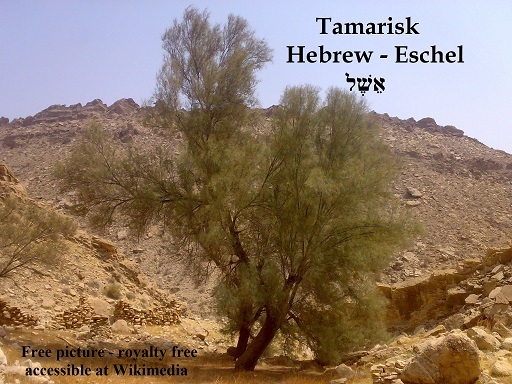
The second plant is the “broom tree” called the rotem in Hebrew. It is likely this is the bush that Hagar and Ishmael were under in the shade. It is a large bush that provides just enough shade for one person. It is likely the bush that Elijah was laying under when he escaped from Ahab and Jezebel. See the rotem below.

I also am linking you to lesson 34 in this series. Hagar is the first person in the Torah to encounter the ANGEL OF THE LORD. It happens in chapter 21 and back in 16. In lesson 34 I show that the Torah, the very words of God, PROVE unequivocally that the ANGEL OF THE LORD is God, a manifestation of the Lord Himself. It is one of the “faces” of the Lord so that He can make Himself visible to us and we will not die. Here’s the link to lesson 34 - https://lightofmenorah.podbean.com/e/the-gospel-according-to-moses-genesis-lesson-34-gen-161-16/
Who is this guy, Rev. Ferret?
 Ferret someplace near the Jordan River
What's his background? Why should we take time to listen to him? Here's a link to check out his background - click here
Thursday Jun 12, 2025
Thursday Jun 12, 2025

FIVE SMALL STONES
EPISODE 18 PART 1
"WHO'S YOUR NEIGHBOR?"
THE GEOGRAPHY OF THE GOOD SAMARITAN
(Here's the link for part 2 - https://lightofmenorah.podbean.com/e/five-small-stones-18-par-2-geography-of-the-good-samaritan/)
Bible reading and study are necessary for a true Christian, a real disciple (talmeed) of Adonai Yeshua - not just reading. Are you in a church that provides Bible classes and training? You'd better be or that church is NOT attempting to obey Jesus' command to make disciples. To make a disciple directly implies Bible study besides reading.
Or perhaps your church is one with a lot social programs and fellowship and cookouts and fun activities. All these are important. They are critical for developing a community. But, in Jesus' day the study of the Bible was considered the highest form of worship! STUDY! Not a Sunday service. Not music and singing. Not a men's group or women's group. Not prayer. But, STUDY.
There was a saying in Jesus' day among the rabbis of which He was the greatest. It shows that study leads to learning and learning's purpose is to know how to Do.
In these two 5-minute videos (part 1 and 2) we will study the Bible. We will study it with the geography of ancient Israel in mind. We will see how knowing the geographical background of the parable of the Good Samaritan adds to and enriches our understanding of this story Jesus told.
In these videos I mentioned resources and references that prove that the inn in the parable was a very real place. It was even excavated by Israeli archaeologists. I even met one of them when I was on a research trip to Israel and visited the exact location.
Here's the 1st link. it is an article from Biblical Archaeology Review. I assume you have to be a member to access the complete article. I highly recommend you join this scholarly site since it will be a critical resource for your Bible study and reading. Below you'll find the link but below are two highlights from the article.
See below for the highlight from the article - note the "inn" referenced in this segment refers to the museum called "The Inn of the Good Samaritan." It even gives the names of the archaeologists who excavated the palace built by Herod. (Click on the image to enlarge)
Here's the link to the article from Biblical Archaeology Review mentioned above.
Link - https://www.baslibrary.org/biblical-archaeology-review/38/1/8
This link is to a awesome academic article proving beyond a shadow of doubt that there was an inn on the Jericho road at the location of the Good Samaritan Museum. The inn likely was formerly Herod's palace at this site. Here's the link ...
https://www.jstor.org/stable/j.ctt1x76gr7.5?seq=7
Shown below are two more excellent scholarly sites (free access) and their corresponding articles on the parable of the Good Samaritan. Once again, these are awesome sites to save for future reference.
HolyLandSite.com - https://www.holylandsite.com/inn-of-the-good-samaritan
BibleWalks.com -https://www.biblewalks.com/goodsamaritaninn/
In one of my many classes I taught on the Jewish parables of our Jewish Rabbi, Yeshua. One parable I focused on was the parable of the Good Samaritan. Here's a link to the complete chapter from the class book.
Rev. Ferret - who is this guy?
What's his background? Why should I listen to him? Check his background at this link - https://www.dropbox.com/s/ortnret3oxcicu4/BackgrndTeacher%20mar%2025%202020.pdf?dl=0
Wednesday Jun 11, 2025
Wednesday Jun 11, 2025

The amazing confrontation between the one true and only God and Pharaoh is about to begin. The Lord is setting the stage for the second meeting of Moses and Aaron and Pharaoh. But this time Moses is to be God to Pharaoh. God does not say Moses will be “like a god,” but He says to Moses he will be God to Pharaoh. Wow!! Moses will be a in the flesh representation of the Lord, or Yahvay, the name of God. Makes sense, though. Pharaoh said he did not know of the God of the Hebrews. So, God would now, through Moses, use His power to show first, the Pharaoh is not a god and, second, to overwhelm Pharaoh and the might of Egypt to free all Israel. In a sense God would through a man, Moses, who is to act as His representative and defeat all the gods of Egypt. Thus this affirms in God’s own words that He is God alone and there is no other …
“Do not tremble and do not be afraid; have I not long since announced it to you and declared it? And you are My witnesses. Is there any God besides Me, or is there any other Rock? I know of none.” (Isa 44:8)
“I am the LORD, and there is no other; Besides Me there is no God. I will gird you, though you have not known Me.”(Isa 45:5)
A second aspect of all this relates to the fact that the Jewish people say that Moses is like the coming Messiah. Moreover, the coming Messiah will be like Moses. God promises this in Deut. 18:15 and 18:18. The Messiah will be a prophet like Moses. In Exod. 7:1 we get the connection between Jesus’ words in John 5:39 and see that if Moses is like the coming Messiah, and Moses is a prophet of Yahvay, Moses is to be as God to Pharaoh, and Moses is sent to Pharaoh and, thus, we too see that Yeshua, our Jesus, is also a prophet as Moses, and Yeshua is GOD not a representation, and as Moses was sent, so Yeshua was sent.
Here’s a part of a great article at the website, “You’ve Got Questions,” on Moses and Messiah.
Jesus is like Moses in several ways. Moses was both a prophet and a lawgiver, and Jesus is, too. Jesus was widely recognized as a prophet who spoke the Word of God (Matthew 21:46), and He gave commandments for His followers to obey (John 13:34; 15:12, 17; Galatians 6:2). Both Moses and Jesus mediated a covenant between God and men—Moses the Old Covenant (Exodus 34:27; Acts 7:44), and Jesus the New (Luke 22:20; Hebrews 9:15). Both Moses and Jesus were born during perilous times, and both narrowly escaped a king bent on murdering babies (Exodus 1:22 and Matthew 2:16–18). Both Moses and Jesus had a connection to Egypt (Exodus 2:1–4 and Matthew 2:13–14). Moses was the (adopted) son of a king (Exodus 2:10), and Jesus is the Son of the Most High (Luke 1:32). Moses spent forty years as a shepherd (Exodus 3:1), and Jesus is the Good Shepherd (John 10:11, 14). Both Moses and Jesus were known for their meekness (Numbers 12:3 and Matthew 11:29).
See the entire article at this link - https://www.gotquestions.org/Moses-and-Jesus.html
A great link to study this further is at the great website, Hebrew4Christains. Here’s the link to the correlation of Moses and the Messiah – https://www.hebrew4christians.com/Articles/Like_Moses/like_moses.html
Also, see the picture below. It is a visual representation of the connection between Moses and the Messiah and the Passover in Egypt in 1446 B.C. and the Passover in Jerusalem in 30 A.D.

But we are to be disciples of Jesus. This means we are to be like Him, to be like our rabbi. That’s what it meant in Jesus’ day. But, if Jesus is prefigured in Moses, aren’t we also, if we are disciples, if we are to be like Jesus? Yes. As Messiah, He was sent and so are we, just like Messiah and just like Moses. As Jesus is given the words to teach like Moses, we are as well. As Jesus is the Light of the World He tell us we too are to be the Light of the World. What do we conclude? That Moses is an example of a disciple of Adonai – one who is like the Lord. So too then we are to be disciples of the Messiah. Check out the article by Ray Vander Laan entitled, “Rabbi and Talmideem (disciples)” at this link. It is a great article on what it means to be a disciple in Jesus’ day and not what the church teaches today. Link - https://www.thattheworldmayknow.com/rabbi-and-talmidim
Who is this guy, Rev. Ferret?

Ferret near Eilat Israel
What's his background? Why should we take time to listen to him? Here's a link to check out his background - click here
Sunday Jun 08, 2025
Sunday Jun 08, 2025

Today is Shavuot (Pentecost) ... by God's own word in Acts 1:8 this feast is the Power Feast of the Lord. Jesus did not say to stay in Jerusalem till you receive tongues ... Jesus did not say to stay in Jerusalem till you receive spiritual gifts ... NO!! He said stay till the Holy Spirit comes to give us POWER to go and bring HIM to the ends of the earth.
Saturday Jun 07, 2025
Saturday Jun 07, 2025

Shavuot - Episode 7
Let’s consider those amazing connections between what happened at Sinai and during Pentecost shortly after Jesus’ ascension. These amazing connections are pictures to us today of God's amazing power to bring us to a deeper and more enhanced understanding that the feasts of the Lord, all eight of them, are shadows of the Messiah. Consider …
- Both events occurred on mountains known as "the mountain of God."
- Exo 24:13 So Moses arose with Joshua his servant, and Moses went up to the mountain of God. (Ex. 24:13; Isa. 2:3). The mountain of God in the Sinai when the Lord gives the Ten Commandments.
- But, the mountain of God moves. The Lord changes its location.
- Consider what we read in the book of Isaiah, “And many peoples will come and say, ‘Come, let us go up to the mountain of the LORD, To the house of the God of Jacob; That He may teach us concerning His ways And that we may walk in His paths.’ For the law will go forth from Zion And the word of the LORD from Jerusalem.” (Isa 2:3 )
- Or in the book of Joel we read, “Then you will know that I am the LORD your God, Dwelling in Zion, My holy mountain. So Jerusalem will be holy, And strangers will pass through it no more.” (Joe 3:17)
- Then again in the book of Micah, “And it will come about in the last days That the mountain of the house of the LORD Will be established as the chief of the mountains. It will be raised above the hills, And the peoples will stream to it. Many nations will come and say, ‘Come and let us go up to the mountain of the LORD And to the house of the God of Jacob, That He may teach us about His ways And that we may walk in His paths.’ For from Zion will go forth the law, Even the word of the LORD from Jerusalem.” (Mic 4:1-2)
- Both events happened on day 50.
- They arrived at Sinai in the third month on the very day (Ex. 19:1). “In the third month after the sons of Israel had gone out of the land of Egypt, on that very day they came into the wilderness of Sinai.” (Ex. 19:1)
- In Hebrew “on that very day” means they arrived on the third day of the third month exactly 50 days after their first Passover meal in Egypt. The feast of Shavuot is to happen on the 50th day after the weekly sabbath during Passover and Unleavened Bread (Lev. 23:15-16).
- Both involved similar sounds and symbols, such as wind, fire, and voices (Ex. 19:16-19; Acts 2:1-3).
- Note that the Hebrew for "thunder" (kolot) means "voices" (Acts 2:4).
- Jewish tradition said that the Israelites heard God speak in 70 languages or, to translate direct from the Hebrew, God spoke in tongues!
- Both events involved the presence of God (Ex. 19:18,20; Acts 2:4).
- About 3,000 people died because of their sin when Moses received the Torah (Ex. 32:28). About 3,000 people believed (were born again into new life) when the Spirit came (Acts 2:41).
- At Mount Sinai, God wrote his revelation on stone tablets (Ex. 31:18). On the fulfillment of Pentecost, God wrote his law on people's hearts as he had promised He would (2 Cor. 3:3; Jer. 31:33).
- Torah means "teaching." The Spirit, given on Shavuot, also became the "Teacher" of the new community of Jesus' followers (John 14:26)
- Many Jews from all over the world heard in their own language from a bunch of kids, young men and women, who only knew Aramaic, Greek and Hebrew. These 120 disciples of Yeshua received "power" and spoke in other language they didn't know or understand.
- All the people, probably hundreds of thousands at the Temple on Shavuot, heard the Gospel!! Peter did a short five minute speech and 3000 wanted to be baptized. It was as if it was SINAI REPEATED!! This is part of what Jesus meant when He said they’d receive “power.”
- Both events were times when God’s people entered a NEW covenant with the Lord.
- Israel became a new nation, a nation of priests, and nation that would be the light of the world (Ex. 19:6, Isa. 49:6).
- And, for us, we have entered a NEW covenant with the Lord as we take the cup of Messiah in His Last Seder meal (Luke 22:20).
- We too become a new people, a new nation, a royal priesthood (1 Pet. 2:9-10). We to are to be the light of the world (Mat.5:14, Acts 1:7-8). But, this time, this covenant is the covenant to restore all people to Himself as our sins our totally cleansed and forgiven.
- This is the final covenant for Jew and Gentile to become one flock with one shepherd, the Good Shepherd, the Messiah Jesus (John 10:14-16). The Shadow of Messiah.
- On Shavuot there is a special sacrifice. Amazingly it uses two loaves of LEAVENED BREAD (Lev. 23:17). Is God giving us a picture that Jew and Gentile are a new people, a new culture, a holy nation, His two flocks coming together as ONE permeated and saturated with His Holy Spirit dwelling in us and through us? Is God helping us see that His Bible is ONE book, about ONE God, about ONE Gospel, ONE Baptism, and ONE Savor of all – Yeshua!

Friday Jun 06, 2025
Friday Jun 06, 2025

SHAVUOT - EPISODE 6
Adonai is connecting Passover to First Fruits (Bikkureem) and First Fruits to Shavuot or Pentecost. It is so clear. When we put these events into their historical context of 1446 B.C. or the time of the first Passover, and in 30 A.D., the probable time of Jesus' death an resurrection, ascension, and the feast of Pentecost in Acts 2, we see how the missing pieces of Pentecost are filled in. Our understanding is again enriched and enhanced and we ask ourselves, how did we miss so much? Why isn't Pentecost Sunday a big deal in my church?
In this lesson I hope you will become as passionate as I in terms of the fact we in the "church" need to bring back Pentecost Sunday and make it a big deal again. It is more, much more, than what some say is the "birthday of the church." Shavuot, its Hebrew name, is integrated into the special season, the season of God's ways of deliverance, salvation, redemption, and renewal.
Hear the words of Jesus, the Good Shepherd,
"I am the good shepherd, and I know My own and My own know Me, even as the Father knows Me and I know the Father; and I lay down My life for the sheep. I have other sheep (us Gentiles), which are not of this fold (Israel); I must bring them also, and they will hear My voice; and they (Jew and Gentile) will become one flock with one shepherd." (Joh 10:14-16)
This is the gathering in of His believers as one flock, one people, or one assembly - in Greek ECCLESIA which is translated as CHURCH. The gathering of His assembly seems to begin in John 1 when two followed Jesus. One was Andrew, Peter's brother. More were added as Jesus came to them and said, "Come. Yes, come. Follow me." Shavuot is when the Lord poured out upon us POWER to be His witnesses to GO and make disciples and take God's Salvation (Yeshua - Jesus' name in Hebrew - means salvation!) and take God's Yeshua to the ends of the earth. Our POWER day is PENTECOST.
Here are the links referenced in this lesson.
Ray Vander Laan's audio lesson on Shavuot - https://www.thattheworldmayknow.com/shavuot
Tutorial of the feast of Shavuot presented by the Temple Institute in Jerusalem - http://templeinstitute.org/shavuot/
Rev. Ferret's lesson from his book entitled, "The Spring Feasts: the Shadows of the Messiah" - https://www.dropbox.com/s/2rs9dwl481eb9s1/Chapter%204%20-%20The%20Spring%20Feasts%20-%20the%20End%20of%20the%20Beginning.pdf?dl=0
Rev. Ferret - who is this guy?

Ferret teaching in northern Israel at Tel Omrit
What's his background? Why should I listen to him? Check his background at this link - https://www.dropbox.com/s/ortnret3oxcicu4/BackgrndTeacher%20mar%2025%202020.pdf?dl=0
Thursday Jun 05, 2025
Thursday Jun 05, 2025

SHAVUOT - EPISODE 5
Where did the the events of Acts 2 happen? In the upper room? Some say it had to be since the disciples were all frightened to be jailed and persecuted like Jesus. But, were they frightened by the time Shavuot comes around? Remember, Jesus rises from the dead in the 1st day of the Omer (listen to lesson 1) - He rises from the dead on the feast of First Fruits, Bikkureem. Forty days pass - over 5 weeks - and Jesus ascends to the Father. Were those disciples cowering in the upper room for 40 days and 40 nights? Absolutely not. The Bible is clear and precise on this. Moreover, on Shavuot where would be the only place to find a large crowd of religious Jews? Where is the ONLY place you'd find a large crowd of 3000 who wanted to be baptized after they heard Peter's sermon? Where?
The important point of all this is just as God chose the 40th day for His Son to return (the Ascension) God also picked a precise location for the coming of the Holy Spirit ( רוח הקודש Ruach HaKodesh) upon the 120 disciples. The 40th day was full of meaning if you were a Jew in 30 A.D. a disciple of Jesus witnessing the ascension. Likewise, the location of the events in Acts 2 is chosen by God since it makes the connection of Passover to Pentecost.
Here are the links I mentioned in this podcast.
Link to Rev. Ferret's article on Bikureem and First Fruits and the count of the Omer - https://www.dropbox.com/s/vca81ywpv8nu900/Article%20from%20book%20BIKKUREEM%20final.pdf?dl=0
Link to the Shavuot tutorial at the website for The Temple Institute - https://templeinstitute.org/shavuot/
Link for an article on where is Mt. Zion - https://www.seetheholyland.net/mount-zion/
Rev. Ferret - who is this guy?
 Ferret someplace in the Jordan Valley south of Beth Shean
What's his background? Why should I listen to him? Check his background at this link - https://www.dropbox.com/s/ortnret3oxcicu4/BackgrndTeacher%20mar%2025%202020.pdf?dl=0